


Begin typing your search...
Slaughterhouse waste finds its way into lakes
Indiscriminate dumping of slaughterhouse waste (feathers, shredded animal carcasses, skin and entrails) on lake beds, street bins and vacant land plots is turning into a health and environmental hazard.
Chennai
A walk around Keezhkattalai and Sithalapakkam Lakes reveals a startling amount of fowl feathers and animal viscera, dumped on the lake bed, amidst the usual plastic trash. Arun Krishnamurthy of Environmentalist Foundation of India (EFI), which conducts regular clean-ups of these lakes, said that the amount of slaughterhouse waste dumped on these lakes increases during the weekends.
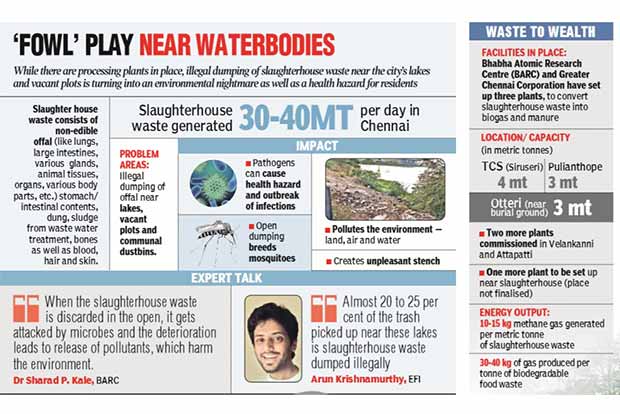
“Almost 20 to 25 per cent of the trash picked up near these lakes is slaughterhouse waste — feathers and shredded animal waste, which are illegally dumped in the middle of the night. This indiscriminate dumping, especially in our lakes, can pollute the waterbody. There is an unpleasant odour. Moreover, this also leads to breeding of mosquitoes, which can cause health hazards,” he said, adding that it is not just the lakes but also vacant plots, roadside bins and other such areas, where slaughterhouse waste is dumped illegally.
Health hazard
Dr Sharad P Kale, Head, Nuclear Agriculture and Biotechnology Division, Bhabha Atomic Research Centre (BARC), said slaughterhouse waste should be treated as biological waste — processed before being disposed. Dr Kale has been instrumental in setting up the plants in Chennai, along with the Greater Chennai Corporation. “After the slaughter, remains like intestines, liver, heart and lungs are usually discarded, which becomes an environmental problem. When the slaughterhouse waste is discarded in the open, it gets attacked by microbes and the deterioration leads to release of pollutants. BARC’s Nisargruna project aims at using the slaughterhouse waste to generate biogas and natural manure. In Chennai, we have set up three plants — in TCS (Siruseri), Otteri (near burial ground) and in Pulianthope. Two more have been commissioned by the Corporation of Chennai in Velankanni and Attapatti. We are also working with the Corporation to set up another plant near the slaughterhouse (place is not yet finalised). These plants process the biodegradable waste to release biogas and natural manure,” explained the scientist.
Processing capabilities
On an average, the city generates 30 to 40 metric tonnes of slaughterhouse waste daily. Dr Kale added, “The plant at TCS has a capacity of four metric tonnes whereas the others have the capacity of three metric tonnes per day. The one which we are planning to set up at the slaughterhouse will be able to handle five metric tonnes of waste. The slaughterhouse waste can generate about 10 to 15 kg methane gas per metric tonne while biodegradable food waste can generate 30-40 kg methane gas per metric tonne.”
An official from the Tamil Nadu Pollution Control Board (TNPCB) said that slaughterhouses must handle these wastes properly. “The three slaughterhouses in the city are disposing their waste as per the norms and sending it to the plants. Other than these slaughterhouses, no other party can engage in slaughtering. So far, we have not been informed about slaughterhouse waste being dumped openly,” said the source.
Awareness needed
Despite the availability of these plants, Arun said that an attitudinal change is the need of the hour. “We have personally spoken to small and medium establishments in the vicinity but there is hardly any understanding or cooperation,” he added.
Dr Kale said, “We have to inform the common man to recycle waste effectively and to ensure there is no environmental pollution. It is not only about the amount of biogas generated through these plants but the efforts taken to reduce the harmful impact on the environment — like pollution of lakes and our country. The environment economic liability has to be managed and this the top priority for everyone.”
Visit news.dtnext.in to explore our interactive epaper!
Download the DT Next app for more exciting features!
Click here for iOS
Click here for Android

Next Story